- Taylor. S.C. (1909) the origin of the werewolf superstition.1. Available from: https://ia802606.us.archive.org/9/items/originofwerewolf00stewrich/originofwerewolf00stewrich.pdf [Accessed last- 02/02/2017].
Wednesday, 26 April 2017
The origin of the Werewolf legend
Clinical Lycanthropy
In
the psychological field there is precedent to my realistic take on the
metamorphosis from human to non-human. Although there is no evidence to suggest
the physical transformation from human to animal, there is to suggest a
transformation on a mental state. Clinical lycanthropy, is a rare form of
reverse metamorphosis (a variant of inter- metamorphosis in which patients
believe that they have transformed into another entity) wherein patients
believe that they have the ability to transform into a non-human creature (Shrestha. 2014). However despite cases of clinical
lycanthropy existing since the 1800’s, case in point a male patient with
delusions of lycanthropy diagnosed in 1850 (Blom. 2014.
91), the condition has received very little attention, possibly because “original case studies
have always been rare” (Blom. 2014. 88). Whereas it’s mythical
counterpart Lycanthropy, which has been known and described since ancient
times, has remained an evocative theme up until present day. So why do tales of
hybrid beasts continue to interest people more than factual cases of people mentally
transforming into their animalistic counterparts? Clinical lycanthropy patients
reportedly display psychotic, animal-like behaviours; howling loudly in their
rooms, sprinting abruptly, crawling on all fours (Shrestha.
2014).
- Blom, J. D. (2014). "When Doctors Cry Wolf. A Systematic Review of the Literature on Clinical Lycanthropy". History of Psychiatry 25: 87–102. Available from: http://journals.sagepub.com/doi/pdf/10.1177/0957154X13512192 [Accessed last- 21/01/2017].
- Shrestha. R. (2014) Clinical Lycanthropy: Delusional Misidentification of the self, Available from: http://neuro.psychiatryonline.org/doi/pdf/10.1176/appi.neuropsych.13030057 [Last visited- 05/02/2017].
Psychoanalysis and ecology at the edge of chaos
- Dodds. J. (2011) Psychoanalysis and ecology at the edge of chaos, Complexity Theory, Deluze/ Guattari and Psychoanalysis for a climate in crisis. Routledge.
Primary source of the study of human and non human relations and portrayals in modern media such as film in the horror and the science fiction genre.
Thursday, 20 April 2017
H R Giger's alien
sources:
Giger's Alien Paperback – 3 Jan 1998
Giger’s creature is a filthy, primal parasite whose very survival is contingent on it’s continued rape and exploitation of other species. If this sounds like a familiar concept, it’s because, at least according to Giger, it was an accurate, if a little pessimistic, reflection of humanity’s most basic function. Throughout his career, Giger made a point of highlighting the dark side of the human life cycle so often worshipped as a source of hope and positivity.
Giger's Alien Paperback – 3 Jan 1998
by H.R. Giger
https://psmag.com/the-horrible-philosophy-behind-the-star-of-alien-h-r-giger-s-xenomorph-fe6cce83b827
Necronom IV. (Photo: H.R. Giger)
My work revolves strongly around the basis of using unsettling organisms to represent dark aspects of the human condition in an ambiguous style. I have always been fascinated by the alien antagonist from Ridley Scott's 1979 film "Alien", created by the Swiss artist H R Giger. I have looked into the philosophy behind the creature and its highly relatable to my own practice. Giger’s creature is a filthy, primal parasite whose very survival is contingent on it’s continued rape and exploitation of other species. If this sounds like a familiar concept, it’s because, at least according to Giger, it was an accurate, if a little pessimistic, reflection of humanity’s most basic function. Throughout his career, Giger made a point of highlighting the dark side of the human life cycle so often worshipped as a source of hope and positivity.
The Horrible Philosophy Behind the Star of ‘Alien,’ H.R. Giger’s Xenomorph
By Daniel Snyder
There’s an inevitable obstacle that arises in the conceiving of fictional alien life: Our own inability to conceptualize life that is not, at least in some small way, a reflection of us. The “grays,” probably our most well-known fictional visitors, with their large heads and bulging eyes, are fairly obvious distortions of the standard human physique.
When Academy Award-winning Swiss artist H.R. Giger passed away on Monday, he left behind, among his endless menagerie of horrors across a wide array of media, including painting, film, sculpture, and music, one of the most unique depictions of alien life ever put to screen. The titular alien, heretofore referred to as the Xenomorph, from Ridley Scott’s 1979 science fiction horror classic, wasn’t inspired by the stars. Instead it came from deep within mankind (sorry John Hurt) and somehow developed into something more alien and terrifying than anything from the unknown.
Unlike many of its galactic fellows, the Xenomorph doesn’t fly around in a spotless ship of unfathomable technology. Giger’s creature is a filthy, primal parasite whose very survival is contingent on it’s continued rape and exploitation of other species.
More optimistic conceptions of alien life involve two key traits. The first is a high level of technology which has not only allowed their race to travel great distances, but, more importantly, has freed them from the need for aggression. Prior to Alien, Close Encounters of the Third Kind became a critical and commercial hit behind the idea of a mysterious but ultimately friendly and benevolent alien visitors. They possessed a level of technology that not only allowed travel at great distances, but had seemingly allowed them to eliminate the need for violence against another species. The second key trait is expanded mental capacity or enlightenment through which the aliens have achieved interstellar cooperation with other races, such as in Star Trek’s universe of largely peaceful interspecies interaction, and/or psychic abilities. The idea of the enlightened alien is an inherently optimistic reflection of humanity. It is our best qualities extrapolated into the far future. Our best hope for ourselves.
Famed science-fiction screenwriter Dan O’Bannon (Total Recall, Dark Star) and Ronald Shusett, who wrote the original draft of Alien, wanted to make a movie about interspecies rape. The script called for a creature that, after impregnating one crew member on the space freighter, The Nostromo, would go on to force itself on the rest of the crew. For that, they needed a creature that reflected not the best that life in the known universe had to offer, but the worst. O’Bannon had worked with H.R. Giger on Chilean director Alejandro Jodorowsky’s failed adaptation of Dune and remembered his terrifying designs. He gave Alien director Ridley Scott a copy of Giger’s Necronomicon. In it, they found the perfect basis for their movie monster, Giger’s Necronom IV.
Unlike many of its galactic fellows, the Xenomorph doesn’t fly around in a spotless ship of unfathomable technology. Giger’s creature is a filthy, primal parasite whose very survival is contingent on it’s continued rape and exploitation of other species. If this sounds like a familiar concept, it’s because, at least according to Giger, it was an accurate, if a little pessimistic, reflection of humanity’s most basic function. Throughout his career, Giger made a point of highlighting the dark side of the human life cycle so often worshipped as a source of hope and positivity. While we celebrated births and treasured our existence, Giger produced pieces like Erotomechanics VII, which sapped thought and feeling from the act of reproduction and reduced them to what he saw as the truth: the cold, mechanical struggle to survive. To Giger, sex and birth could be pain and even kill. Every life, he posited in his piece Birth Machine, carries the potential for suffering. In Necronom IV, we see the phallus and the monster depicted as one, a fusion of a symbol of life with its inherent potential for pain and trauma. Giger’s message was very clear: That thing between your legs is also an instrument of evil.

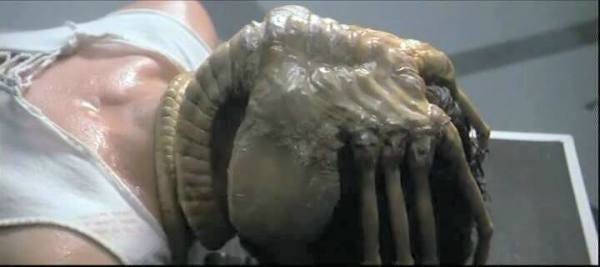
The facehugger. (Photo: 20th Century Fox)
Giger’s philosophy was apparent in the Xenomorph’s physical being, but it made its way into the creature’s life cycle, too. It began with forced entry, with the facehugger pushing its embryo down a host’s throat. Its birth — a forced exit — would be even more violent, bursting forth from the host’s chest cavity, inextricably linking its life to the death of another creature. As an adult, it kills with another phallus, a set of pharyngeal jaws. This is what made the cold, unthinking Xenomorph so terrifying and made Alien as much a horror film as it was science fiction. It turned our own weapon against us, so to speak, and showed us the terror of what we do to each other and the creatures we torture and exploit every day as a matter of simple survival. It was a penis come to life, running amok in a ship full of dark corners.
None of this is meant to take away from what O’Bannon, Shusset, and Scott achieved with Alien — which made Scott a household name, earned back its budget 10 times over, and made a star out of Sigourney Weaver as much as the Xenomorph itself — but they were undeniably gifted a great treasure in Giger’s creation. While others looked to the stars for inspiration, the Xenomorph was dredged from the filthy and most basic truths of our existence, a look backwards at our primordial selves. Seeing that on screen was more terrifying than any green-skinned, antennae-sporting alien in a UFO.
Tuesday, 4 April 2017
Machine life
This article supports the notion that humans could one day soon leave the boundaries of our current condition and leap into a more mechanical life.
This is the link to the article: https://www.theguardian.com/science/2017/mar/25/animal-life-is-over-machine-life-has-begun-road-to-immortality?CMP=fb_gu
Friday, 24 March 2017
Pandorum
Pandorum
is a German-British 2009 science fiction
horror film,
with elements of Lovecraftian horror, and survival adventure. The film was directed by Christian Alvart
and produced by Robert Kulzer, Jeremy Bolt
and Paul W.S. Anderson. Travis Milloy wrote the screenplay from a story by Milloy and Alvart.
It stars Dennis Quaid and Ben Foster.
Filming began in Berlin in August 2008. Pandorum
was released on 25 September 2009 in the United States,[3] and on 2 October 2009 in the UK.
The film's title is a nickname
of a fictional psychosis called "Orbital Dysfunctional Syndrome" (ODS
for short) caused by deep space
and triggered by emotional stress leading to severe paranoia, delirium, and nosebleeding. The film received mixed to
negative reviews, but has gained a cult following
over time.
After watching this
film I felt it was a greatly underappreciated movie with an intriguing view on
the future and nature of the human condition. The human race has had to abandon
earth due to excessive overpopulation, therefore a huge transport ship called
Elysium transports 60,000 humans 500 million miles from earth on a 124 year
journey to the only planet with an appropriate atmosphere, and water to sustain
humans. On board the Elysium are embryos for every organism on earth; thus the
Elysium is an interesting twist on Noah’s ark.
However the film
gets interesting towards the end after the plot twist and explanation (SPOILERS) which reveals that the vast horde of monstrous,
cannibalistic humanoid hunters which have been the films primary antagonist,
are in fact the descendants of humans. It is revealed that the ship arrived at
Tanis (the new world) 900 years ago at which point the first rotation crew
awoke to run the ship. Finding that the ship was in deep space a place with no
stars just black (later revealed to be the bottom of an ocean on Tanis) and a
message from earth telling them that Earth has been destroyed, the CO goes
insane kills the remaining skeleton crew. He then believes that this ship is
the new home of the human race of which he is in control thus he believes
himself to be the new god. He wants to ensure over population never threatens
the new world. Therefore he realizes that he only way to keep population manageable
the human race must revert to the primal uncanny, their origins. To return to a
state of savage violence in which you are either the butcher or the meat. To do
this he wakes several thousand humans from hyper sleep and locks them in the
cargo section of the ship to play a horrifying game of cat and mouse forcing
them to kill and eat each other to survive (survival of the fittest). An enzyme
every human receives in hyper sleep to accelerate evolution so as to adapt to
the climate of Tanis actual allows these cannibals to evolve to adapt to the
ship and a new savage, violent lifestyle. After seeing his work take effect the
new god Gallo goes back into hyper sleep waking as Payton 800 years later
starting the events of the film. After 800 years the descendants of the humans
have evolved into the monstrous hunters that are the antagonists.
However in the end the protagonist Bower and Nadia discover all of this and that the ship is below the sea, therefore after accidental shattering the bridge window they escape to the surface in a hyper sleep pod acting as an escape pod. All the remaining humans in hyper sleep are also ejected to the surface whilst the ship floods drowning the hunters and Payton revealed to be the main villain who created the new human race. Therefore as with Noah’s ark the water saves the pure and cleanses the evil.
There is a scene
during Pandorum in which Bower meets a survivor called Cook, who resides in an
exhaust outlet on the walls of which he has documented the evolution of the
monstrous hunters revealing the secrets of the ship and revealing Gallo to be
the villain. The history is documented as cave drawings, which is interesting
as it clearly shows the de evolution of the human race to their new savage
selves by using a primal style of art work.
Subscribe to:
Posts (Atom)